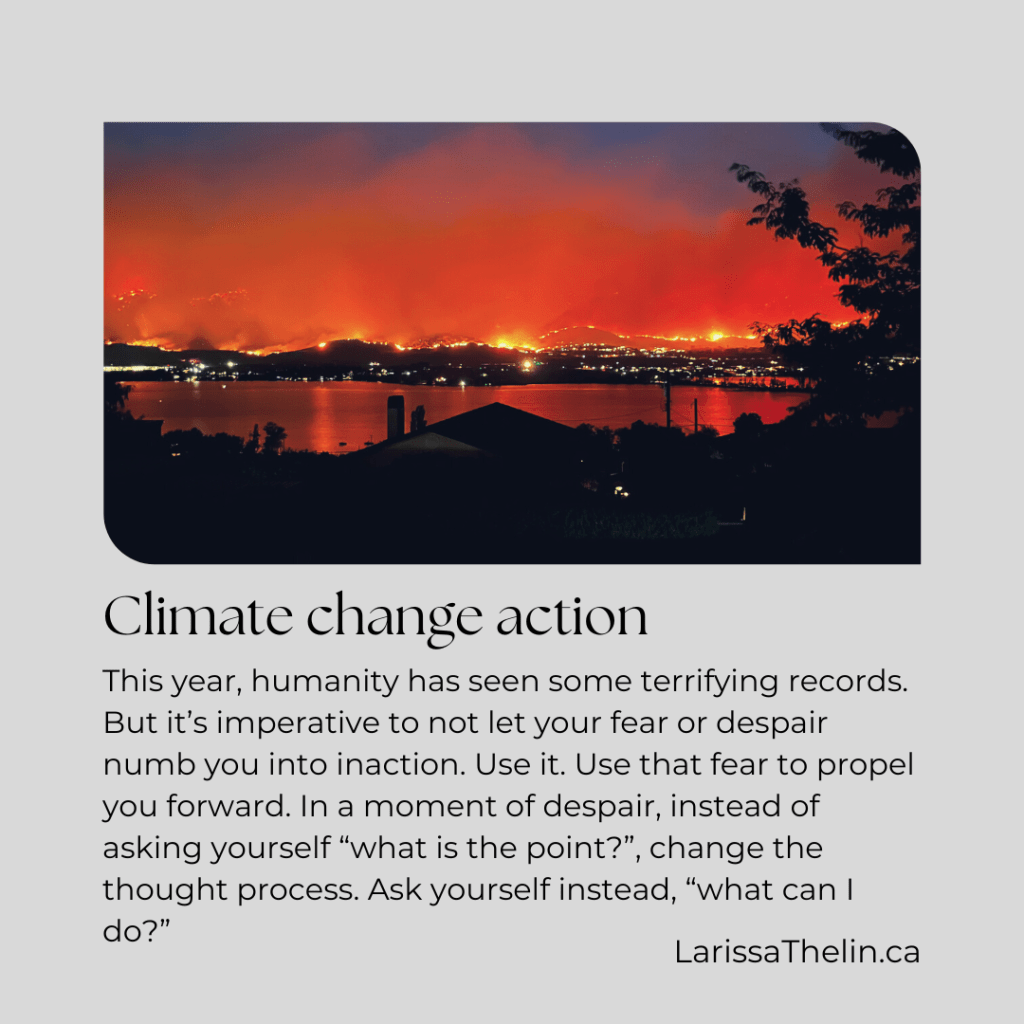
This year, humanity has seen some terrifying records. Climate change has caused heat extremes on land and in waters across the world, as well as extreme flooding and unprecedented wildfires in many areas – and yet, summer in the northern hemisphere is far from over. Not to mention, these headlines seem to be increasing in numbers each year.
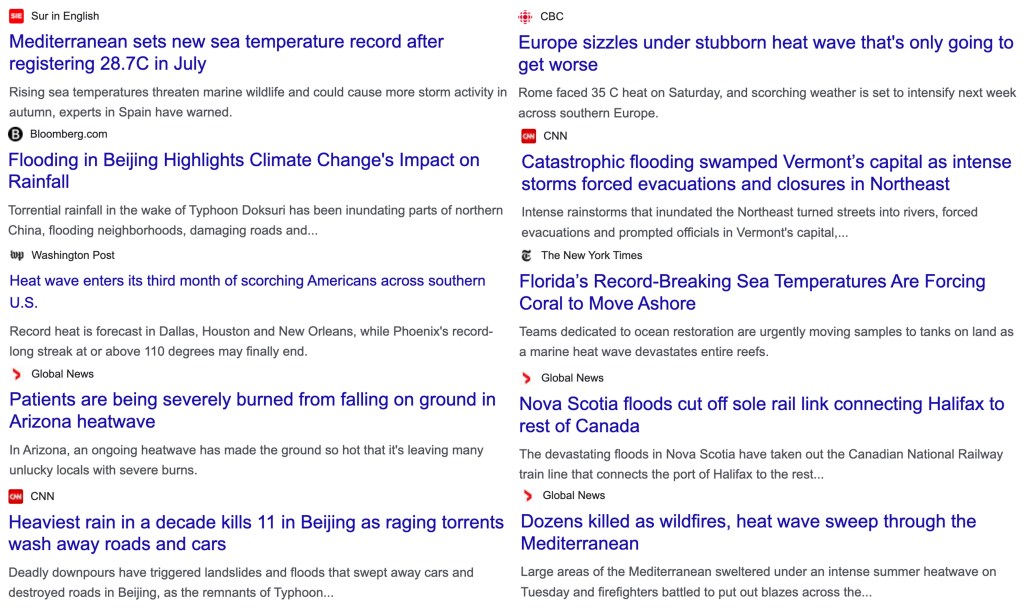
A collage of news headlines from July 2023.
For many of us, the trajectory that our planet seems to be on can cause extreme overwhelm. I see it all the time. In my work as a science communicator – and because I have experience with mental health – I have begun to pick up on subtle keys that I am losing my audience to despair. Recently, I was talking to a group of people in the Polar Bears International Ice House about the ways that climate change is affecting polar bears. During the 10 minutes I was talking, I noticed one woman in particular taking deep breaths in through her nose and out through her mouth. This woman was clearly managing her anxiety, something I am all too familiar with. I quickly moved through the problems and spent more time than I normally do slowly and clearly explaining the solutions. I finished by pointing out our take-away list of action items that people can do to help save Arctic sea ice. Her breathing returned to normal, and she took multiple copies, thankful for the resource.
I had a break in the flow of guests after that interaction and stepped outside for air. The overwhelm was starting to affect me too, and I felt my eyes welling up. But I was overwhelmed for a different reason. It is not despair, for I am confident we can mitigate climate change. But for those of us working in climate advocacy, our efforts can be exhausting. It is often us holding the hope for both ourselves, and for others. It is us spreading the faith we have in humanity. People turn to us not just for the information itself but also for the hope that the mitigation is even possible. This becomes more than just teaching scientific information – there is a real emotional toll involved with those of us in any form of advocacy.
To those of you in climate activism, my best advice is to take care of your mental health and find your people. When we’re surrounded by people doing the same work, that emotional toll is lessened – the hope is carried on our collective shoulders, not just ours alone. I have found my people in classmates and colleagues – in student-led university groups and for the last couple of years in the people working for NGOs like Polar Bears International. There are many of us doing this work and we are stronger together. And we do our best work when we’re each taking care of our mental and emotional health. So, make sure to prioritize your own health, and take space away when you need to recharge. When I start to feel overwhelmed, remembering everyone else that is also doing this work is what helps refocus and reenergize me. And if that doesn’t work, I take the time I need to cultivate peace and get back to a stable place, normally doing so by spending time in nature to remind myself of what it is I am fighting for. Nowadays, I might be overwhelmed for a minute, but after years of teaching climate change science, I can quickly shake those feelings and get back to work. I’ve noticed that spending time as an Ambassador for Polar Bears International (i.e., working with my people) seems to invigorate my advocacy every time. And the best way I know how to make a difference is to teach what I have learned.
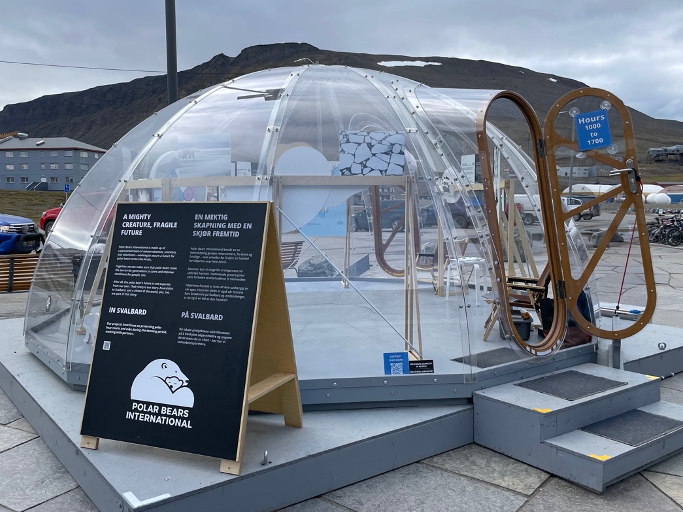
Polar Bears International Ice House.
So, why do I have such confidence that climate change will be mitigated? First, I have hope. We know exactly what to do to mitigate climate change, we have the means to get us there, we lack only our political willpower. On top of that, it’s openly covered through the media and discussed on international stages, and our youth are teaching us a thing or two about advocacy. There is a surge in youth-led advocacy that you can feel like a hum across the world if you’re paying attention. All of this gives me immense hope. And secondly, I have faith. Faith that humanity can do the right thing. And the most important piece is that this faith is grounded in reality, for we have pulled together for a common goal before.
In the 1970s humanity realized we had a little issue on Earth1. There is a layer within the stratosphere made up of ozone, a gas that protects us from the most harmful of (cancer-causing) ultraviolet radiation2. And we discovered a hole in it (or rather, a large, depleted area) over Antarctica1,3. Scientists learned that chlorine and bromine destroy ozone molecules when they contact it in the atmosphere and that these two chemicals are released through human activity4. We release them through using ozone-depleting substances, such as chlorofluorocarbons (CFCs), which include a variety of gases that humans have used in refrigeration, aerosols, air conditioning, and insulation, etc1,4. Once these CFCs are released into the atmosphere, they create chlorine and bromine, which eat away at the ozone4.
Luckily for us and our planet, governments around the world met in 1987 and unilaterally agreed to phase out CFCs1,5-6. The Montreal Protocol is known as one of the most successful environmental agreements ever made – it is the only UN Treaty signed by every single nation in the world. Today, the ozone layer is still being monitored by NASA3 and it is estimated to be fully recovered by 20506. Interestingly, many of the gases banned in the agreement are also greenhouse gases – unintentionally, the Montreal Protocol helped lessen the impacts of climate change7. It is also an example of politicians listening to scientists, and it worked. We have done this once. We can do it again. That is where my faith comes from.
Now, what about hope?
I was in high school when I first heard the phrase “global warming”. My parents, other family members, and friends had never heard of it before either. Yet, here we are, less than 2 decades later, and you simply cannot avoid the topic of climate change. The media hasn’t always done a great job of covering the subject in a clear, scientifically-sound way – they tried to be “fair” by showing both “sides” of the climate “debate” and offering climate change deniers a platform8. They’ve also accepted money from fossil fuel companies who’ve used media networks for their own advertising8. But this has been improving – in the last few years, the media (for the most part) has been more accurate in the ways that it communicates climate change8. It isn’t perfect, but the fact that it has been improving gives me hope. The media is key to the public’s understanding of climate change8 – the more it’s covered in an honest and science-informed way, the more the average person understands the seriousness of the issue. The more we understand, the greater chance we have at tackling this problem together.
In 1992, the UN’s Framework Convention on Climate Change was established, which aims to cultivate international cooperation to mitigate climate change through the reduction of each country’s emissions9. This framework led to the Kyoto Protocol, to the Paris Agreement, and to the Conference of the Parties, a yearly meeting where international leaders can discuss their progress and commitments to combating climate change9. There is a lot of criticism about these international meetings by climate activists that believe too much debate and discussion result in not enough action. There is certainly a lot to be improved at these meetings. But the fact that these discussions are happening is a feat that must be acknowledged. It is not easy to get most of the world’s leaders and representatives together for one common goal, but they are happening and that’s a start. Climate activists, and the climate itself, will continue to put pressure on our leaders to ensure these discussions become more action-focused and at quicker pace.
Speaking of activists, our youth give me endless hope. Greta Thunberg was able to capture the attention of the media in 2018 like none before her, but there were many before her. That same year, Autumn Peltier gave her first UN address about clean drinking water at just 12 years old. At that point, she had already spent years fighting for clean drinking water for Indigenous communities in Canada and now advocates for the climate as well. Mari Copeny was 8 years old when she sent a letter to President Obama in 2016 about the Flint water crisis, causing him to head to Flint himself, garnering international recognition of the problem. She now also advocates for the climate. Helena Gualinga and her family have been opposing the oil industry in Ecuador for decades; she was just 17 when she presented at the 25th Conference of the Parties in Madrid in 2019. And there are many more youth like them around the world. These powerhouses of climate advocacy are an unbelievable source of inspiration for me. It is mind-boggling to me that when I falter, I look to those younger than me for inspiration. I believe that this is both a testament to the seriousness of climate change, and to the fact that environmental issues are finally being publicly acknowledged and openly discussed. The youth are involved because they feel as though they have no other choice – those of us from older generations have not been doing a good enough job. Social media has been helping to change this – it has allowed us to learn about these issues happening anywhere on Earth in real time, and the youth have taught us to use that media to rally together. Greta’s Fridays for Future is now known internationally – youth from countries all over the world strike every Friday in a massive display of solidarity for our one planet. If this doesn’t give you hope in your heart, you are simply not paying attention.
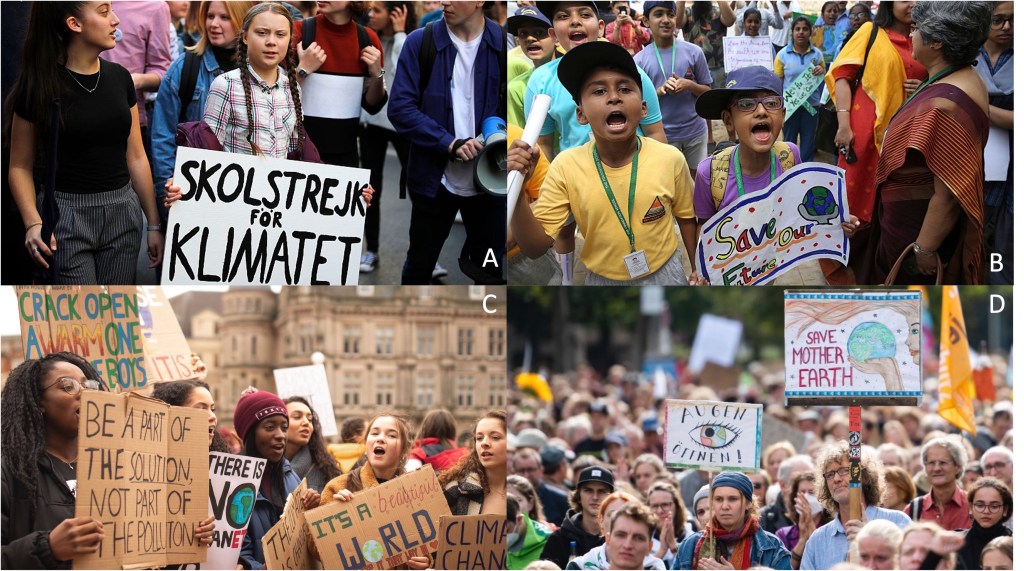
A collage of images of youth striking for the climate. Photographs from various sources: A) Francis Mori at euronews.green; B) Manish Swarup at euronews.green; C) Callum Shaw at Global Citizen; and D) Marius Becker at CTV News.
But what gives me the most hope of all is that we know exactly what we must do. We know that burning fossil fuels leads to more greenhouse gases in the atmosphere. We know that this is heating up our world through the exacerbation of the greenhouse effect. And we know we need to limit emissions in order to stop the warming (read my blog post about this here). It’s a simple formula.
The important questions are, where exactly are these emissions coming from, how do we lessen them, and what’s the hold up? The latest report by the Intergovernmental Panel on Climate Change (read my blog post about them here) breaks down the science of these questions and their solutions8,10. The burning of oil and coal are the two leading causes of emissions, particularly through their use in our energy systems and in industry8. Agriculture, forestry, and other land uses also makes up a large proportion of our emissions, with transportation not far behind8. Addressing these issues requires system-level changes, such as shifting to renewable energy sources, investing in energy-efficient technology across all sectors, and creating policy to better manage energy, industry, land use, and transportation8,10.
So, we know what to do, we know how to do it, and we know that these changes are absolutely necessary. So, what exactly are we waiting for? The answer: our politicians. This is why the Conference of the Parties is such a headache for those of us in climate advocacy – they have become avenues for lip-service rather than spaces to facilitate urgent, real change. There are many things we can do as an individual to be mindful of and reduce our emissions in our everyday lives, such as paying attention to what companies we support through our purchases or being mindful of how far our food travels to reach us (i.e., eating more locally). But system-level changes are really what is needed to curb the vast majority of our society’s emissions. That’s why, the most effective things we can do is to education ourselves and our loved ones, and most importantly, to vote for parties that are going to establish the policies that are needed for these system-level changes.
Climate change is caused by us. How incredibly naïve it is to think that we cannot also reverse it. I am not victim to climate despair because mitigation is entirely possible. Being confident in that is the only thing that makes sense to me. Yes, this is a big, scary, and overwhelming crisis. It would be easier to throw our heads in the sand and ignore it. But it’s imperative to not let your fear or despair numb you into inaction. Use it instead. Use that fear to propel you forward. In a moment of despair, instead of asking yourself “what is the point?”, change the thought process. Ask yourself instead, “what can I do?” We all have things that we are good at; now is the time to do an inventory of your skillset and think of how you can use them for climate advocacy. This advocacy can look a hundred different ways. You could be including climate change within the curriculum of a class you teach. You could be joining or starting protests in your own city. You could be learning where your bank invests their money and divesting from them if they are supporting fossil fuel companies. You can teach your friends about this to help them transition too. You could be eating less meat each day and convincing your loved ones to do the same. You could be growing your own food and teaching your children the importance of that. You could be writing about or photographing these issues and sharing them with your networks. Or you could simply be elevating voices that are trying to do that through your own social media accounts. You can always learn more about it and spread that knowledge far and wide. You can also be correcting climate change deniers or muting them so that their accounts do not reach an audience. We need the voices of those of us who understand and who care about climate change to be louder and stronger than the ones who don’t. This is how we create a society that understands this problem and values our planet enough to do something about it.
But most important, you can be voting with the climate in mind. So please, in every municipal, regional, or national election, vote. Vote like your lives, your children’s and grandchildren’s lives, your nieces’ and nephews’ lives, depend on it. Because they do. Vote like the future of polar bears, of coral reefs, of every swimming, flying, migrating, flowering organism do too. Because they do. Vote like the future of humanity depends on it. Because it does. And when politicians regress on the promises they make for our planet, then we protest. We must all work together to put pressure on our politicians. Only then will they have no choice but to listen. Only then will these system-level changes take place.
Fear and despair are only debilitating when we don’t know how to use it. But now you know how, so let it fuel you.
As always, don’t just trust my word. Below are resources where you can learn more.
Sources
- National Oceanic and Atmospheric Administration. (2023). 4 facts you might not know about the ozone and the Montreal Protocol.
- National Geographic Society. (n.d.). Ozone layer.
- National Aeronautics and Space Administration. (n.d.). Ozone facts: What is the ozone hole?.
- United States Environmental Protection Agency. (2021). Basic ozone layer science.
- United States Environmental Protection Agency. (2023). International actions – the Montreal Protocol on Substances that Deplete the Ozone Layer.
- UN Environment Programme. (n.d.). About Montreal Protocol.
- Centre for Climate and Energy Solutions. (n.d.). The Montreal Protocol.
- Intergovernmental Panel on Climate Change. (2022). Working Group III contribution of the Sixth Assessment Report of the Intergovernmental Panel on Climate Change: Mitigation of climate change.
- United Nations Climate Change. (n.d.). History of the convention.
- Intergovernmental Panel on Climate Change. (2022). Mitigation of climate change: Summary for policymakers.
 Larissa Thelin